New - 6 Hours Ago


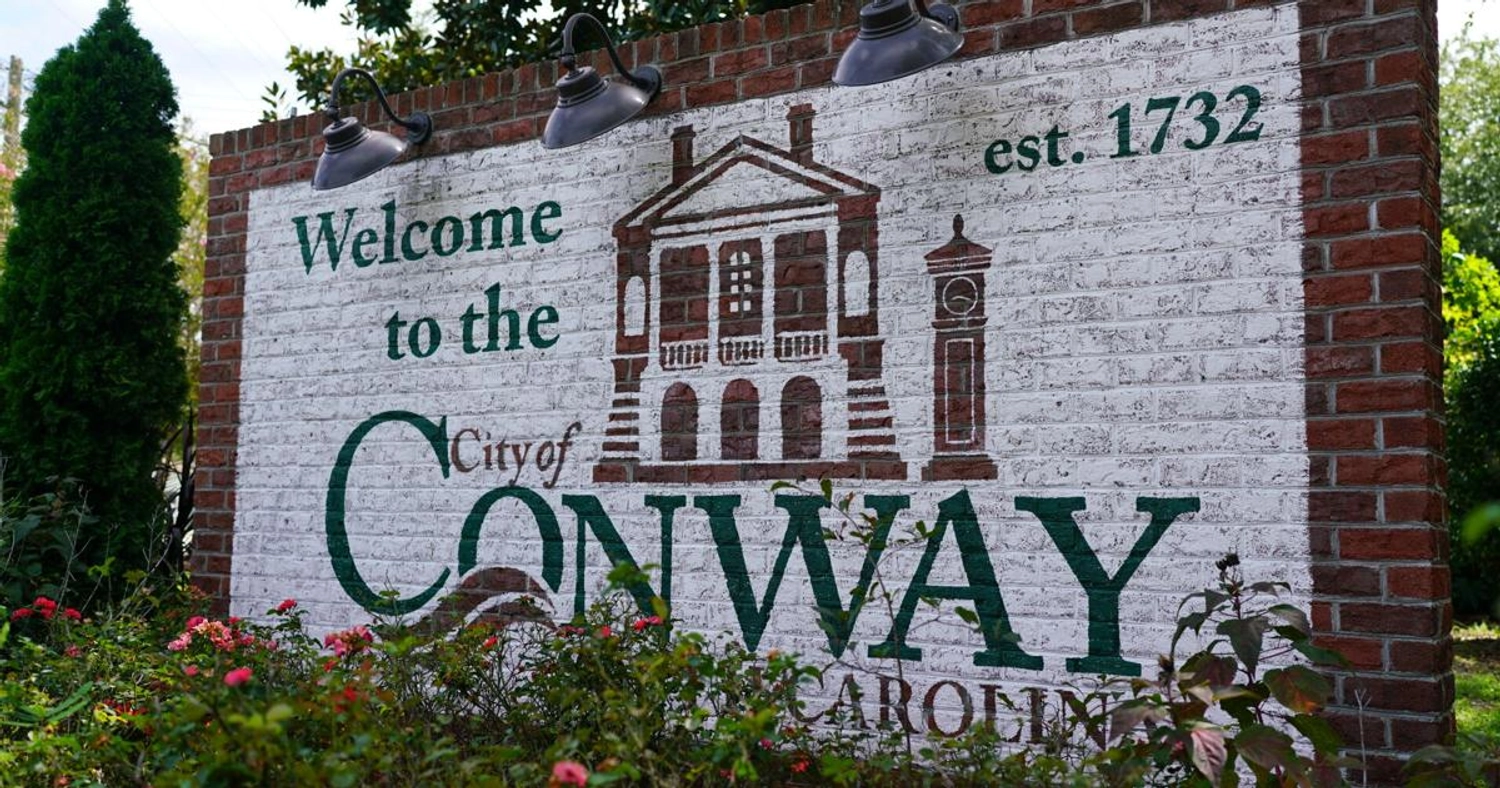
So you're wondering whether Conway, SC is a good place to live — and you want a straight answer, not a sales pitch. Good, because that's exactly what the Homes Myrtle Team delivers.
Conway is the county seat of Horry County, tucked about 25–40 minutes inland from Myrtle Beach along US-501. It's not a beach town, but it might be a smarter one. A historic riverfront downtown, signature live-oak canopy, Coastal Carolina University, and home prices well below the coastal communities give Conway a real case as one of the Grand Strand's best-kept secrets.
It's not perfect. There's a genuine flood story here, summer heat that does not forgive, and a beach commute that requires planning. We'll cover all of it — the good and the bad — so you can decide with your eyes open.
The Conway Riverwalk along the Waccamaw River is one of the most charming waterfront amenities in the entire Grand Strand area — and most visitors have never heard of it. The mile-long boardwalk winds through cypress trees and Spanish moss, with views that feel closer to the Lowcountry than to a beach resort. Local restaurants, boutiques, and events like Art in the Park make the historic downtown a genuine place to spend a Saturday afternoon, not just a backdrop for photos.
The surrounding streets are lined with well-preserved homes from the early 1900s and an antiques district that draws buyers from across the Carolinas. If you've moved from a bigger city and miss the feel of a real downtown, Conway delivers it at a fraction of the price.
Drive down Laurel Street or Kingston Street in Conway's historic core and you'll understand why long-time residents never want to leave. The old-growth live-oak canopy creates a cathedral-like tunnel of shade that is genuinely rare on the Grand Strand. Combined with Victorian-era architecture, a walkable grid of streets, and a slower pace of life, Conway has an approachable Southern character that beach towns with 15 million annual tourists simply cannot replicate.
Coastal Carolina University (CCU) adds an energy and an economy to Conway that inland towns its size rarely enjoy. The university brings roughly 10,000 students, a calendar full of sporting events, performing arts, and a steady stream of young professionals who choose to stay after graduation. The CCU Research and Technology Park is also attracting employers looking for affordable space near a college talent pipeline. For homeowners, proximity to a university is historically one of the most reliable anchors for long-term property values.
This is the headline reason most buyers start looking at Conway seriously. The median home price in Conway runs meaningfully below comparable properties in Myrtle Beach, North Myrtle Beach, and Surfside Beach — you can still find well-maintained homes under $300,000 in established neighborhoods, a price point that has largely vanished from the coastal zip codes. Property taxes are also modest, and South Carolina's overall tax environment — including no estate tax, favorable retirement income treatment, and a homestead exemption for residents 65 and older — makes a dollar go further here than in most other southeastern states.
Every summer, the coastal neighborhoods of the Grand Strand see their populations swell with visitors. Conway sits far enough inland to miss the worst of it. Your grocery store isn't packed with sunburned vacationers in June. Your favorite restaurant has a table on a Friday night. Your neighborhood stays yours. For buyers who want beach access when they want it — but don't want to live in the middle of a resort economy — Conway's inland position is a genuine quality-of-life advantage.
As the county seat of Horry County — one of the fastest-growing counties in South Carolina — Conway is where the courts, county government offices, and major institutions are headquartered. That administrative role brings stable employment and investment. The broader Grand Strand region has grown steadily for a decade, and infrastructure improvements that follow population growth — roads, schools, medical facilities — tend to filter into Conway before they reach the smaller surrounding towns.
Conway is inland. The beach does not come to you. On a typical weekday, the drive from downtown Conway to public beach access on US-501 takes roughly 25–35 minutes. During summer, with tourist traffic building on the main corridor, that same drive can stretch to 40 minutes or more. If you need the ocean every single day, or if you're buying specifically for short-term rental income in a beachfront market, Conway is not the right address. But if the beach is a weekend trip rather than a daily commute, the distance is easy to manage — and the savings on your purchase price will likely cover a lot of beach parking and ice cream.
This is the con that demands the most honest treatment. The Waccamaw River has a long history of flooding, and Hurricane Florence in September 2018 was a watershed moment — in the most literal sense. Florence stalled over the Carolinas and dumped extraordinary rainfall across the region. The Waccamaw crested far above its banks and flooded large sections of Conway, including neighborhoods that had never experienced significant flood damage before. Some streets saw floodwaters remain for weeks. The damage was measured in hundreds of millions of dollars across Horry County.
What does this mean if you're buying in Conway today? It means flood zone research is not optional — it's essential. Check FEMA's Flood Map Service Center before you make any offer. Homes in high-risk flood zones (AE, VE, or similar designations) require flood insurance on top of standard homeowner's insurance, and that combined cost can be significant. Some properties were removed from flood zones after post-Florence elevation studies and new FEMA map revisions; others were added. Your Homes Myrtle Team agent can help you understand exactly what zone any property sits in, and what that means for your insurance budget. Buying smart here is entirely doable — but it requires doing the homework.
Coastal breezes moderate temperatures along the shore. Conway doesn't benefit from that same cooling effect. Summer days regularly push into the mid-90s°F, and the combination of heat and humidity in July and August is intense. This isn't unique to Conway — it's a Lowcountry reality — but buyers moving from the Northeast or Midwest should factor in the adjustment period. Good news: most South Carolina homes are built with robust HVAC, screened porches, and tree coverage that make the heat manageable. The winters, by contrast, are genuinely mild.
US-501 is the main artery connecting Conway to Myrtle Beach, and like most of the Grand Strand's road network, it was not built for the volume of traffic it now carries. The corridor is actively being widened in sections, but construction zones and bottlenecks are a regular feature of the commute. Conway itself is also growing — new retail, housing developments, and commercial projects are multiplying — and the infrastructure is still catching up. If you commute to the beach towns daily for work, plan your schedule around peak traffic windows.
Conway does not have a beachfront dining strip, an oceanfront hotel district, or the concentrated entertainment corridor that Myrtle Beach offers. The restaurant and nightlife scene is smaller, and the retail options — while growing — are not yet as deep as the coastal communities. For some buyers, that quiet is exactly the point. But if you need the buzz of the beach at arm's reach on a random Tuesday, Conway will require a drive for that too.
Conway is located approximately 14–15 miles inland from the Myrtle Beach oceanfront, and the drive time via US-501 is typically 25–40 minutes depending on traffic and your precise starting point within Conway.
The closest public beach access is at Myrtle Beach State Park (about 29 miles from downtown Conway, roughly 35–40 minutes) or the public beach access points along Ocean Boulevard in Myrtle Beach (approximately 14–15 miles, 25–35 minutes under normal conditions). During summer peak season — especially on weekends and holidays — US-501 can back up significantly, and the drive time toward the beach can extend to 45–50 minutes. Heading home from the beach in the late afternoon during summer requires patience.
The practical takeaway: Conway residents have easy, regular access to one of the best-known stretches of beach on the East Coast. It just requires a short drive. Many Conway homeowners come to see this as a feature rather than a flaw — you enjoy the beach on your schedule, and you come home to a quieter community.
Want to explore what's available closer to the water? Compare our Pros and Cons of Living in Myrtle Beach guide, or see our Best Myrtle Beach Suburbs roundup to find the right balance for your lifestyle.
Ready to Find Your Conway Home?
Browse all available Conway, SC listings and connect with the Homes Myrtle Team — local experts in Horry County real estate.
View Conway Homes for SaleConway consistently ranks as one of the most affordable places to live in the Grand Strand region. Here's what buyers should know in 2026:
Home prices: The median home sale price in Conway runs well below coastal communities in Horry County. While Myrtle Beach and North Myrtle Beach have seen median prices push well past $350,000–$400,000+ in popular neighborhoods, Conway still offers solid single-family homes in established areas in the $250,000–$320,000 range, with new construction developments available at various price points depending on the community.
Property taxes: South Carolina's property tax rates are among the lowest in the Southeast. The owner-occupied primary residence ("legal residence") exemption significantly reduces the assessed value used to calculate taxes, making a real difference in the annual tax bill for full-time Conway residents compared to investors or second-home buyers.
State tax environment: South Carolina does not tax Social Security income and offers generous deductions for other retirement income. The state income tax rate has been gradually reduced in recent years. Combined with no estate tax and the general cost-of-living advantage, South Carolina remains a top destination for retirees relocating from higher-cost states.
Cost of everyday living: Groceries, dining, utilities, and healthcare costs in the Conway area track below national averages. Healthcare, in particular, is bolstered by Conway Medical Center, a full-service regional hospital that handles a wide range of care locally — reducing the need and cost of traveling to larger markets for routine and specialist appointments.
For a deeper look at the numbers across the Grand Strand, read our Cost of Living in Myrtle Beach, SC guide. You can also see how Conway stacks up in the broader context of the region in our Best and Worst Things About Living on the Grand Strand.
Conway is not the right move for everyone — but for the right buyer, it's an excellent one. Here's who tends to love it most:
Retirees and near-retirees who want a manageable small city with a charming downtown, mild winters, great tax treatment, and real estate equity that doesn't evaporate with a mortgage half their retirement savings. The healthcare infrastructure, the slower pace, and the natural beauty of the riverfront all align well with this stage of life.
First-time buyers and young families priced out of the coastal communities. Conway gives you room to buy a real house — yard, garage, good neighborhood — at a price point that still makes sense. The Horry County school system serves Conway, and Coastal Carolina University provides a local college presence that adds to the community's cultural calendar.
Remote workers who need a place that feels like home rather than a resort. If your job doesn't require a daily commute to the beach strip, Conway's lower cost basis means your housing dollar works significantly harder.
Buyers who love outdoor living. The Conway Riverwalk, Lakes in the Carolina Forest area, Myrtle Beach State Park, and the broader Lowcountry environment of cypress-lined waterways and Spanish moss are all accessible from Conway. It's a genuinely beautiful part of South Carolina.
If you're thinking about the specific neighborhoods within Conway, check out our companion guide: Top 10 Neighborhoods in Conway, SC (2026) — publishing the same day as this post — for a street-by-street breakdown of where to buy and why.
Also worth reading: Moving to Myrtle Beach and Best and Worst Things About Living on the Grand Strand for broader regional context.
Conway is a great fit for buyers who want small-city charm, a walkable historic downtown on the Waccamaw River, and real estate that costs significantly less than the beach towns just 25–40 minutes away. It's not an oceanfront town, but for the right buyer — retirees, families, remote workers — it checks a lot of boxes that the coastal communities can't at a comparable price point.
Conway is roughly 25–40 minutes from Myrtle Beach public beach access via US-501, depending on traffic and your starting point in Conway. The city sits about 14–15 miles inland from the oceanfront. Plan for longer drive times during summer weekends and holidays.
Parts of Conway are in FEMA-designated flood zones along the Waccamaw River. Hurricane Florence (2018) caused significant flooding in the area, affecting neighborhoods that had not previously experienced major flood events. Before buying, check the FEMA Flood Map Service Center for any property's flood zone designation and budget accordingly for flood insurance. Your Homes Myrtle Team agent can walk you through the flood zone research process.
Conway is more affordable than Myrtle Beach and the other coastal Horry County communities. Home prices, property taxes, and everyday expenses all run below the regional average. South Carolina's favorable tax treatment of retirement income and the owner-occupied property tax exemption make the cost advantage even more pronounced for full-time residents.
Yes. Conway offers quieter neighborhoods, Coastal Carolina University, a walkable historic downtown, Conway Medical Center, and easy access to Myrtle Beach amenities — without the tourist congestion. It's a popular destination for families who want more house for their money and a genuine community feel.
Conway's local economy is anchored by Coastal Carolina University, Conway Medical Center, Horry County government, and regional retail and services. The broader Myrtle Beach metro is one of the fastest-growing job markets in the Southeast, and many Conway residents commute to the beach cities for work in hospitality, healthcare, construction, and technology. Remote work has also increased Conway's appeal as a base for workers with location flexibility.
Conway, South Carolina rewards the buyer who does their homework. The historic Riverwalk, the live-oak streets, the Coastal Carolina University energy, and the meaningfully lower price points are all real. So is the flood story — and any honest agent will make sure you understand it before you sign anything.
If you want beach access without beach-town prices, a genuine downtown without tourist crowds, and a community that has been growing steadily without losing its character, Conway deserves a serious look. It's one of the most undervalued markets on the Grand Strand, and buyers who moved here five years ago will tell you that themselves.
The Homes Myrtle Team specializes in Horry County real estate and knows every neighborhood in Conway. We'll help you find the right street, understand the flood maps, and negotiate a price that makes sense — start to finish.
Start Your Conway Home Search Today
Browse Conway listings and connect with the Homes Myrtle Team — no pressure, just local expertise.
See All Conway Homes for Sale


