New - Just Now
$325,000
Active
2
Beds
2
Baths
920
Sqft
--
Acres
5601 N Ocean Blvd #B 101, Myrtle Beach, SC 29572
MLS#: 2624506


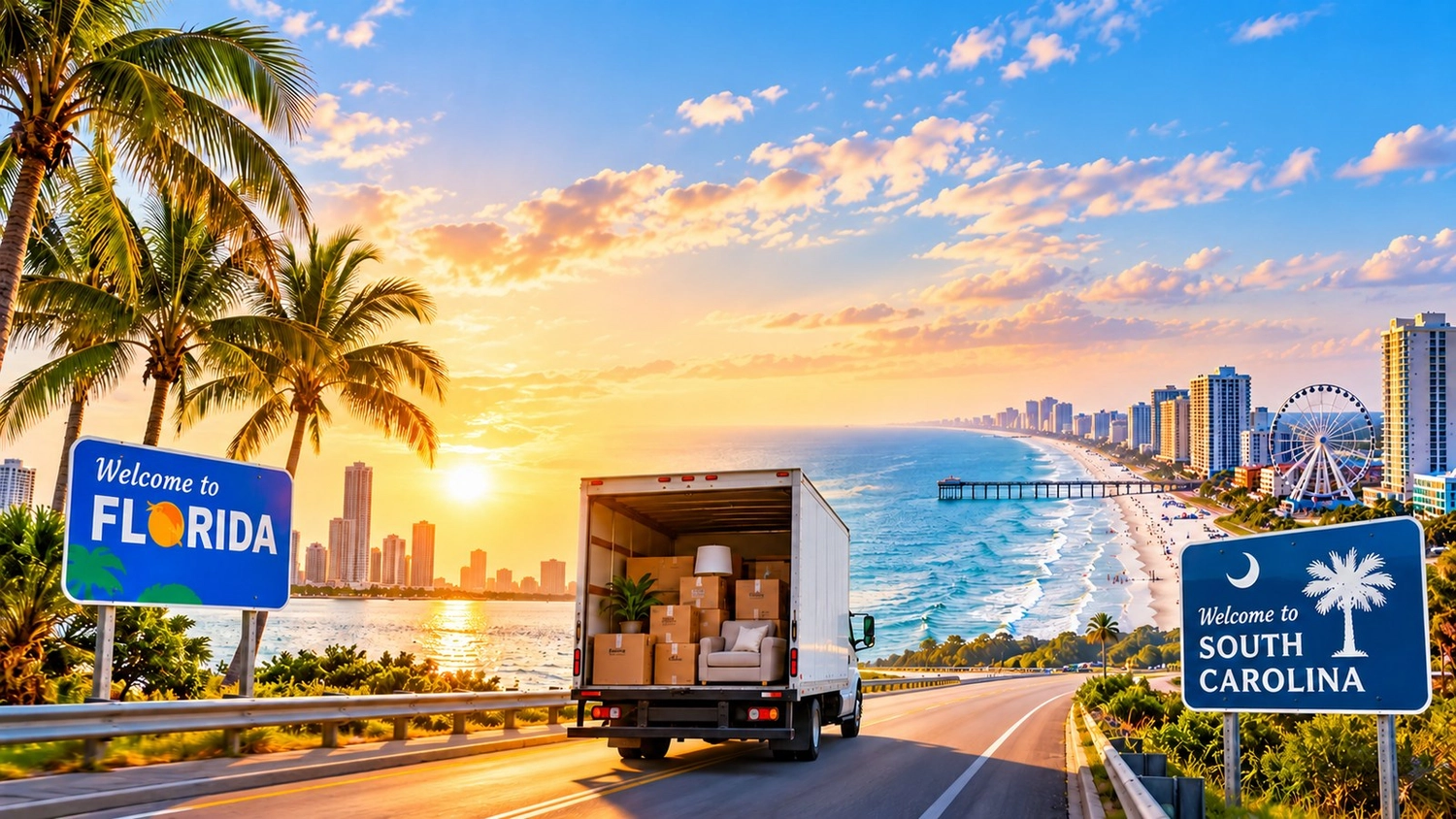
Moving from Florida to South Carolina has become one of the most common relocation paths on the East Coast, and the Myrtle Beach area sits right in the middle of it. If you are a Florida homeowner weighing a move, you are probably not looking for a sales pitch. You want to know what changes with your taxes, your insurance, your roof, and your day-to-day life, and whether the numbers actually work. This guide covers that, as of October 2026, from the Homes Myrtle team at the Secure Home Finder Team with LPT Realty.
South Carolina led every state in net gains of movers age 65 and older in 2025, and Florida was the second-largest source of those movers after North Carolina, according to a Realtor.com analysis. Economists call many of these buyers "halfbacks": people who moved from the Northeast or Midwest to Florida, then moved halfway back north to the Carolinas, Georgia, or Tennessee. A University of South Carolina economist quoted in that analysis pointed to rising Florida insurance costs as a driver, especially for retirees on fixed incomes.
The Myrtle Beach area is one of the fastest-growing metros in the country. Horry County added close to 16,000 residents between 2023 and 2024, according to the South Carolina Department of Employment and Workforce, and Florida, New York, and New Jersey are among the most common origin states for new Grand Strand residents.
The reasons people give are usually practical, not dramatic. You keep the coast, the golf, and the mild winters, you get four real seasons with a milder summer than most of Florida, and you are closer to family in the Northeast and Mid-Atlantic. The part that tips the decision is usually the cost of owning the house.
Search Grand Strand Homes for Sale
In Florida, the age of your roof often decides whether you can keep your homeowners policy. Under Florida Statute 627.7011(5), an insurer cannot refuse to issue or renew a homeowners policy solely because the roof is less than 15 years old. Once the roof reaches 15 years, the insurer can require an inspection, and the home stays insurable on roof age alone only if an authorized inspector certifies at least five years of remaining useful life.
Roof age is counted from the last date the entire roof surface was built or replaced to code, so repairs do not reset the clock. For many Florida owners with a roof in the 15 to 20 year range, that means a replacement before renewal or before listing, since buyers and their insurers run into the same rule.
Florida premiums remain among the highest in the country, though published averages vary widely depending on who is measuring. The Florida Office of Insurance Regulation put the statewide average at about $3,757 a year with wind coverage, using data as of March 31, 2026. Quote-based surveys run much higher: Insurance.com reported an average of $8,471 for a policy with $300,000 in dwelling coverage in 2026. The gap comes from methodology, so treat both as ranges rather than a single answer, and compare your own declarations page.
If you are selling a Florida home, your roof and your insurance history are part of your pricing conversation. A newer roof, wind mitigation features, and a clean claims history make your home easier for the next buyer to insure, which makes it easier to sell.
Coastal South Carolina is not an insurance-free zone, and you should hear that before you hear anything else about it. Hurricanes reach the Grand Strand, and insurers price that risk. The difference is in how coverage is structured and how much of the market is still competing for your policy.
Along the coast, many Grand Strand homes carry two or three separate policies. A common setup is a homeowners policy that excludes wind, a separate wind and hail policy, and flood insurance where it is required or wise. Wind and hail deductibles are usually a percentage of dwelling coverage rather than a flat dollar amount.
South Carolina's coastal backstop is the South Carolina Wind and Hail Underwriting Association, often called the Wind Pool or the Beach Plan. Created by the legislature in 1971, it writes wind and hail coverage for properties in designated coastal territories, including parts of Horry and Georgetown counties, when the standard market will not. Eligibility follows those mapped territories, not whole counties.
The practical rule: get insurance quotes on a specific address before you are past your inspection period. Premiums swing with distance from the ocean, elevation, flood zone, roof type, and age of the home. Newer construction inland often quotes very differently from an older home east of Highway 17, and our team can connect you with local agents who write coverage here every day.
Search New Construction Homes on the Grand Strand
South Carolina taxes an owner-occupied primary residence at a 4% assessment ratio, compared with 6% for second homes, rentals, and most other real estate. The tax is figured as market value times the assessment ratio times the local millage rate. A qualifying legal residence is also exempt from school operating millage, which is often the biggest single line on a South Carolina tax bill.
The 4% rate is not automatic, and you have to apply for it. You file a legal residence application with the county assessor, usually by the first penalty date on that year's tax bill, and counties typically ask for proof such as a South Carolina driver's license, vehicle registration, and voter registration at the address. If you do not apply, the home is taxed at 6%.
Homeowners 65 and older get an additional break through South Carolina's Homestead Exemption. It exempts the first $50,000 of fair market value of your legal residence from property tax, once you have been a South Carolina legal resident for a full calendar year and have qualified for the 4% ratio. It is filed with the county auditor and also covers owners who are totally and permanently disabled or legally blind.
The big difference for Florida owners is what you leave behind. Florida's Save Our Homes cap limits annual increases in a homestead's assessed value to 3%, and long-time owners often have a taxable value far below market. That benefit does not move to another state. In South Carolina, a purchase sets the taxable value at what you paid, and after that, increases on a 4% legal residence are capped at 15% per countywide reassessment, which happens about every five years.
Florida voters will decide Amendment 3 on November 3, 2026. If at least 60% approve, it would raise Florida's homestead exemption for non-school taxes to $150,000 in 2027 and $250,000 in 2028 for qualifying homeowners. It does not change school taxes, and a homestead you sell is no longer yours to exempt, so it matters most to people deciding whether to stay.
One South Carolina cost surprises Florida transplants: vehicle property tax. South Carolina counties bill an annual personal property tax on vehicles, which Florida does not. Budget for it, especially if you are bringing more than one car or a boat.
Search Myrtle Beach Area Homes for Sale
Florida has no state income tax, and South Carolina does, so this is the line item to run carefully. Under H. 4216, signed in March 2026, South Carolina taxes 2026 income at 1.99% on taxable income up to $30,000 and 5.21% on taxable income above that, down from a 6% top rate in 2025. The law also sets up automatic future rate cuts when revenue growth allows.
For retirees, South Carolina's exemptions do a lot of the work. Social Security benefits are not taxed by South Carolina, and military retirement pay is fully exempt. Taxpayers 65 and older can deduct up to $10,000 of retirement income such as pensions and IRA or 401(k) withdrawals, plus a separate age-65 deduction that brings the combined total to $15,000 per person, or $30,000 for a married couple who both qualify.
Many retired couples whose income is mostly Social Security and modest withdrawals owe little or no South Carolina income tax, while working-age earners with salaries will notice it. Because the deductions interact, run your own numbers with a tax professional before you assume either outcome. We are real estate agents, not tax advisors, and this section is general information rather than tax advice.
The median single-family sale price in the Myrtle Beach market was $550,000 in August 2026, up from $515,000 a year earlier, according to South Carolina Association of Realtors data reported by MyHorryNews. That figure covers the 29572 and 29577 ZIP codes, which include many of the higher-priced coastal neighborhoods. In nearby Carolina Forest, the median single-family price was $490,950 in August 2026.
Condos give buyers more room to negotiate right now. The median Myrtle Beach condo sold for $199,000 in August 2026, down from $224,950 a year earlier, and inventory rose year over year. Single-family prices inland in Conway, Longs, and Loris run well below the coastal medians, which is why many Florida movers end up comparing a smaller home near the beach with a larger, newer home 20 to 40 minutes inland.
Treat these numbers as a snapshot. Medians move month to month and differ by ZIP code and property type, so ask us for current figures on the specific areas you are considering. For a full breakdown of everyday expenses, see our cost of living in Myrtle Beach guide.
Search Grand Strand Homes for Sale
The Grand Strand runs about 60 miles along the coast, and its towns feel very different from one another. The fastest way to narrow your search is to think about what you liked about your Florida neighborhood and what you were glad to leave.
Surfside Beach and Garden City offer a quieter, residential beach feel just south of Myrtle Beach. They suit buyers who want to be near the sand without living next to the busiest tourist corridor. Browse Surfside Beach homes for sale.
Murrells Inlet and Pawleys Island are the Grand Strand's Lowcountry side, built around the marsh, the inlet, and a slower pace. Buyers who loved Florida's Gulf Coast fishing towns often feel at home here. Browse Murrells Inlet homes and Pawleys Island homes.
Florida buyers used to amenity-rich communities often look at Market Common and the gated golf communities along the Intracoastal Waterway. Read our guide to every Market Common neighborhood or our Grande Dunes buyer's guide.
Conway, Longs, and Loris offer newer construction, larger lots, and lower prices in exchange for a longer drive to the beach. Conway also brings a historic riverfront downtown and county services. Read the pros and cons of living in Conway.
North Myrtle Beach and Little River sit at the northern end of the Grand Strand, with golf, the waterway, and quick access to the North Carolina beaches. Browse North Myrtle Beach homes for sale.
Get a Personalized Grand Strand Home Search
The hardest part of a Florida to South Carolina move is usually timing two transactions in two states. Most buyers use one of four approaches, and the right one depends on your equity, your financing, and how much risk you can tolerate.
Hurricane season affects both ends of the move. Insurers commonly stop binding new policies in an area while a named storm threatens it, which can delay a closing in Florida or South Carolina. Line up your South Carolina insurance early, and build a little flexibility into closing dates between June and November.
Get pre-approved before you start touring. Lenders will want to see how your Florida sale fits into the purchase, and having that settled first makes your offer stronger. Start with our mortgage pre-approval page.
Search Grand Strand Homes for Sale
For many homeowners, yes, mainly because of insurance and property tax, but it depends on your income. Retirees living mostly on Social Security often come out ahead, while working households give up Florida's lack of a state income tax. Compare your actual insurance, tax, and housing costs side by side.
No, South Carolina does not tax Social Security benefits. It also offers a retirement income deduction for taxpayers 65 and older, worth up to $15,000 per person when combined with the age-65 deduction.
It is often lower, but coastal South Carolina coverage is still a real cost. Many Grand Strand homes carry separate wind and hail coverage, and premiums depend heavily on location and the age of the home. Get quotes on a specific address before you commit.
It is the assessment ratio for an owner-occupied primary residence, compared with 6% for second homes and rentals. You must apply for it with the county assessor, and qualifying homes are also exempt from school operating millage.
A halfback is someone who moved from the North to Florida and later moved halfway back, often to the Carolinas. The term is widely used to describe Florida retirees relocating to areas like the Grand Strand.
No, Florida's homestead exemption and Save Our Homes portability only apply within Florida. In South Carolina you apply for the 4% legal residence rate, and if you are 65 or older, the Homestead Exemption once you meet its residency requirement.
Thinking about relocating from Florida to South Carolina? The Secure Home Finder Team with LPT Realty helps Florida homeowners compare areas, line up insurance, and time both sides of the move. Tell us what you are looking for and we will send you homes that fit.
Search Grand Strand Homes Personalized Home Search Talk to Our Team
Figures in this guide were verified from public sources as of October 2026, including the South Carolina Department of Revenue, the Florida Office of Insurance Regulation, Florida Statute 627.7011, county assessor and auditor offices, and South Carolina Association of Realtors data. Tax and insurance rules change, so confirm current figures with a tax professional and a licensed insurance agent before you make decisions.


